
If your dog has ever wriggled free mid-walk or turned every pavement trip into a tug-of-war, you already know how stressful it feels. Standard harnesses often fail the dogs who need them most, leaving owners frustrated and genuinely worried about safety. A dual clip harness offers a smarter approach, combining two attachment points to give you real control without causing discomfort. This guide covers exactly what dual clip harnesses are, how they work, why fit matters so much, and which dogs benefit most from switching to one.
Table of Contents
- What is a dual clip harness?
- How dual clip harnesses provide control and security
- Why fit and adjustment are critical for safety
- Who should use a dual clip harness (and when to use each clip)
- What most harness guides overlook: comfort, customisation, and the limits of control
- Find the right dual clip harness for your dog’s needs
- Frequently asked questions
Key Takeaways
| Point | Details |
|---|---|
| Versatile control | Dual clip harnesses offer front and back D-rings for switching between training and relaxed walking. |
| Escape prevention | Look for multiple adjustments and padded straps to keep even Houdini dogs safe and secure. |
| Comfort is critical | Correct fit—especially Y-style fronts—prevents rubbing and shoulder restrictions, keeping your dog happy. |
| Pair with training | Harnesses give control, but reward-based training is essential for lasting leash manners, especially in reactive breeds. |
What is a dual clip harness?
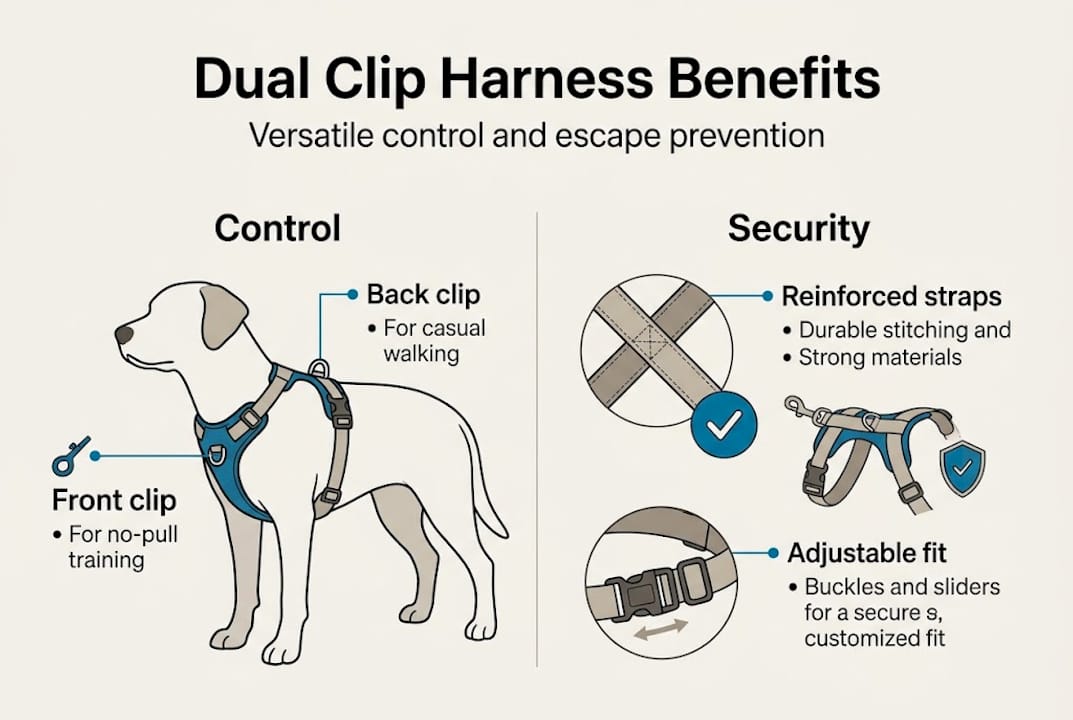
A dual clip harness is built around a simple but powerful idea: two D-rings instead of one. A dual clip dog harness features two D-rings: one on the front chest panel and one on the upper back between the shoulder blades. That single design decision changes everything about how you can manage your dog on the lead.
Single-clip harnesses give you one fixed attachment point. You clip on and hope for the best. With a dual clip design, you choose which ring suits the moment, the environment, and your dog’s behaviour on that particular day.
Here is how the two clips work in practice:
- Front chest clip: When your dog pulls forward, the lead angle turns them back towards you. It disrupts the pulling motion without pain or force. Front chest clip redirects pulling by turning the dog toward the handler, making forward momentum work against the pull rather than with it.
- Back clip: Sits between the shoulder blades and allows your dog to move naturally. Best for dogs who already walk well on the lead, or for relaxed off-lead adventures where you want a comfortable, low-pressure attachment.
The table below summarises the core differences at a glance:
| Feature | Single-clip harness | Dual clip harness |
|---|---|---|
| Attachment points | 1 | 2 |
| Pulling control | Limited | Strong (front clip) |
| Suitable for training | Partial | Yes |
| Versatility | Low | High |
| Escape prevention | Basic | Enhanced |
The escape-proof dog harness features that matter most, like reinforced D-rings and secure buckles, are built into quality dual clip designs from the start. This makes them a far more reliable choice for dogs who have a history of slipping free or testing every piece of kit you put on them.
For reactive breeds, strong pullers, or dogs in training, the ability to switch clips depending on the situation is genuinely useful. You are not locked into one approach. That flexibility alone makes dual clip harnesses worth serious consideration.
How dual clip harnesses provide control and security
Understanding the structure is one thing. Seeing how it changes a walk in real life is another.
The front clip works through physics, not punishment. Front clip uses physics to redirect forward momentum sideways across the chest, while the back clip provides no such redirection. When a dog lunges forward and the lead is clipped to the chest ring, the force of their own movement swings them off course. They cannot build the straight-line momentum that makes pulling so effective. It is not uncomfortable for the dog. It is simply inefficient.
For features for escape-prone dogs, the dual clip design adds a second layer of security. If a dog manages to twist or back out of one position, the second attachment point and the additional strap structure make a full escape far less likely.
Here is a step-by-step look at how control is maintained:
- Choose the right clip for the situation. Front clip for busy streets, training sessions, or reactive moments. Back clip for calm parks or well-behaved dogs.
- Let the harness geometry do the work. The chest clip redirects without pulling back hard on the lead.
- Use the adjustment points to maintain fit. A loose harness loses its mechanical advantage quickly.
- Observe your dog’s response. Some dogs settle into the front clip within minutes. Others take a few sessions.
- Switch clips as your dog progresses. As training improves, you can rely more on the back clip.
Dual clip harnesses offer secure, versatile control for escape-prone and reactive dogs, making them a practical choice for owners dealing with what some trainers call “Houdini dogs,” breeds or individuals who seem to slip free no matter what you try.
For harnesses for reactive breeds, the combination of a secure front clip and multiple adjustment points is particularly valuable. Reactive dogs can generate enormous sudden force, and a harness that shifts or loosens under that pressure becomes dangerous fast.
Pro Tip: Always test the front clip attachment in a low-distraction environment first. Let your dog get used to the different lead angle before trying it on a busy street or near other dogs.
Why fit and adjustment are critical for safety
A well-designed dual clip harness fitted poorly is almost as risky as no harness at all. Fit is where most escape attempts succeed or fail.
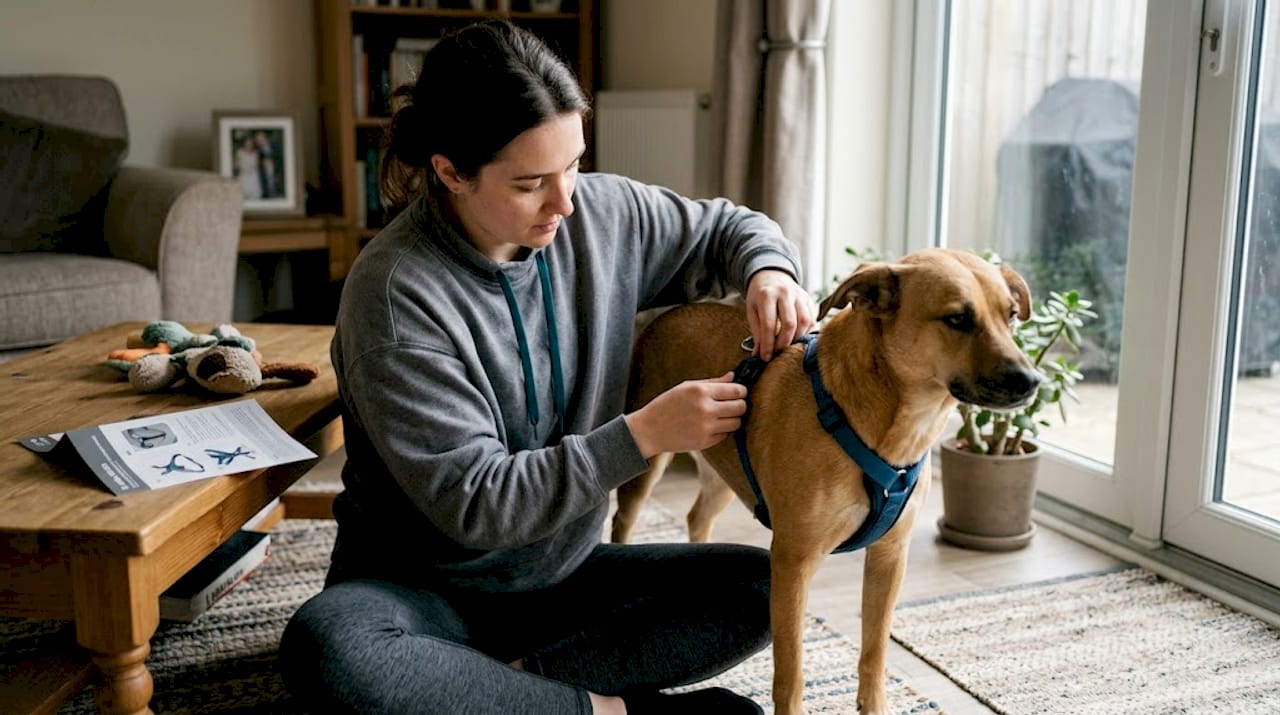
For escape-prone dogs, dual clip harnesses with multiple adjustment points, padded straps, and security features prevent backing out. Look for harnesses with at least four to seven independent adjustment points. This level of customisation lets you close the gaps that a determined dog will find in a simpler design.
Key features to check when fitting:
- Chest and belly straps: Both should sit snug without restricting breathing. You should fit two fingers underneath comfortably.
- Shoulder width: Straps should not dig into the armpits or sit across the top of the shoulder joint.
- Back strap length: Should keep the harness centred without riding forward or backward.
- Buckle security: Metal buckles are more reliable than plastic for strong or reactive dogs.
- Padding quality: Thick, breathable padding reduces chafing on long walks.
Y-shaped front design sits above the shoulder joint to avoid gait restriction, and poor fit causes shoulder issues over time. This matters more than many owners realise. A harness that presses across the shoulder joint does not just restrict movement. It can contribute to long-term joint problems, particularly in active or working breeds.
A harness that fits correctly should look almost invisible on your dog. If you can see it pulling, bunching, or shifting during movement, it needs adjusting before the next walk.
For dogs who are particularly skilled at escaping, look for designs with an extra belly strap or rib strap. These add a third point of contact around the torso, making it nearly impossible for a dog to back out by reversing and dropping their weight. You can find more on harness types to understand which construction suits your dog’s body shape best.
Pro Tip: Recheck the fit every few weeks, especially for young dogs who are still growing or dogs whose weight changes seasonally. A harness that fitted perfectly in spring may need adjustment by autumn.
Also check the proper harness fit guidance before your first walk with a new harness. Getting it right from the start saves a lot of frustration later.
Who should use a dual clip harness (and when to use each clip)
Dual clip harnesses are not just for the most challenging dogs. They suit a surprisingly wide range of situations and breeds.
Dogs who benefit most:
- Escape-prone dogs who back out of standard harnesses
- Reactive dogs who lunge at other dogs, cyclists, or traffic
- Strong pullers of any breed or size
- Dogs in early lead training who are still learning loose-lead walking
- Rescue dogs with unknown history or unpredictable behaviour
- Dogs transitioning from a head collar to a harness
Recommended dual D-ring harnesses consistently highlight these use cases because the design genuinely addresses each one.
When to use the front clip:
- Training sessions focused on loose-lead walking
- Busy streets, markets, or anywhere with high distraction
- When your dog is in a reactive or excitable state
- Early walks with a new or rescue dog
When to use the back clip:
- Relaxed walks in quiet areas
- Dogs who have mastered loose-lead walking
- Running, hiking, or off-lead activities where a front clip could cause tripping
- Calm, familiar routes where your dog is settled
Front clip interrupts lunging and pulling and can reduce pulling by up to 70% within two weeks for reactive breeds. That is a significant shift, but it works best alongside consistent reward-based training. The harness changes the mechanics. Training changes the habit. You need both.
For harnesses for reactive dogs, pairing the right clip choice with positive reinforcement creates a much faster improvement than either approach alone. The harness buys you control in the moment. Training builds the behaviour you actually want long-term.
What most harness guides overlook: comfort, customisation, and the limits of control
Most guides on dual clip harnesses focus heavily on control mechanics and almost entirely ignore what happens after the first few walks. Here is what we have found matters most in the long run.
Comfort is not a secondary concern. A dog who finds their harness uncomfortable will resist wearing it, move awkwardly, or develop negative associations with walks. Padding, strap width, and material breathability are not luxuries. They are part of what makes a harness work day after day.
Fit also changes. Dogs put on weight, lose it, build muscle, or simply grow. A harness that is never re-adjusted slowly becomes a liability. Truly escape-proof solutions require ongoing observation, not just a one-time setup.
The bigger point is this: no harness replaces training and relationship-building. A dual clip design gives you a genuine mechanical advantage, but a dog who trusts you and understands what you expect will always be easier to manage than one kept in check purely by equipment. Use the harness as a tool that supports your training, not as a substitute for it.
Find the right dual clip harness for your dog’s needs
If you have been dealing with a dog who pulls, escapes, or reacts unpredictably on walks, the right harness makes an immediate, practical difference.
At Tetherway, we design escape-proof harnesses specifically for dogs who test standard kit to its limits. Our dual clip harnesses feature multiple adjustment points, zero-chafe air-mesh padding, reflective stitching for low-light visibility, and secure hardware built for strong, reactive, or escape-prone breeds. Every harness comes with a 30-day return policy and free UK returns, so you can find the right fit without risk. See Tetherway’s designs and explore fitting guides to make sure your dog’s next harness is one they cannot wriggle out of.
Frequently asked questions
What is the purpose of a dual clip dog harness?
It allows you to choose between front and back D-ring attachment points for better control of pulling, lunging, or escapes. A dual clip dog harness features two D-rings: one on the front chest and one on the back between the shoulder blades.
Is a dual clip harness better than a single clip harness?
For most escape-prone or strong-pulling dogs, yes. Dual clip harnesses offer secure, versatile control for escape-prone and reactive dogs, making them more adaptable than single-clip alternatives.
How do I fit a dual clip harness to prevent escapes?
Adjust all straps regularly to ensure a snug fit, use extra belly or rib straps for Houdini dogs, and check the Y-design sits above the shoulders. Multiple adjustment points, padded straps, and security features are what prevent backing out.
Can a dual clip harness stop a reactive dog from pulling?
A front clip can greatly reduce pulling, by up to 70% in some dogs within two weeks, but pairing it with consistent reward-based training yields the best and most lasting results.